
EURO TO NAIRA BLACK MARKET CONVERTER
Convert Euros to Nigerian Naira using the Nigerian black market exchange rate.
The exchange rate is temporarily unavailable. Please check back later.
Black market exchange rates are updated daily by MasaMasa. This is an indicative rate and may differ from your final transaction quote.
Convert EUR to NGN
Check estimated Euros to Nigerian Naira conversions for common amounts using the current black market exchange rate.
NGN to EUR
How much Euro your naira is worth
EUR to NGN
Estimated naira value of Euro
Black market exchange rates are updated daily by MasaMasa. Estimates use the same EUR/NGN rate configured in the MasaMasa calculator. They are indicative and are not guaranteed MasaMasa selling quotes.
How Much Is 1 EUR to Naira (NGN)?
Today, the current Euro to Naira black market rate is loading..., €1 is worth loading.... This means €100 equals loading..., €200 equals loading..., €500 equals loading..., while €1,000 is worth loading.... The value of 1 EUR to Naira depends on the prevailing exchange rate and where you exchange your Euros.
If you are searching for the Euro to Naira black market rate today, it is important to understand that the parallel market rate may differ from the official exchange rate. Euro exchange rates in Nigeria fluctuate due to foreign currency demand, availability and changes in the global currency market.
Whether you receive Euros from abroad, make international payments or want to convert your savings into Naira, checking the latest EUR to NGN exchange rate can help you make informed decisions. Use the MasaMasa Euro to Naira calculator above to estimate your conversion before exchanging.
History of Euro to Naira Exchange Rate (1999–2026)
The Euro to Naira exchange rate has experienced significant changes since the introduction of the Euro in 1999. Over the years, the value of the Euro against the Nigerian Naira has been influenced by inflation, foreign exchange demand, monetary policies, economic conditions and fluctuations in the international currency market.
The Euro was officially introduced on January 1, 1999, initially for electronic transactions and financial settlements before Euro banknotes and coins entered circulation in January 2002. Historical reference-rate records provide an early EUR to NGN observation of approximately ₦157.04 on January 4, 1999. This should be treated as a historical reference rather than a universal black-market quotation.
Euro to Naira Exchange Rate from 2010 to 2026
Between 2010 and 2026, the Euro became significantly more expensive against the Naira. In 2010, one Euro averaged approximately ₦197, while the annual average exceeded ₦1,700 in 2025. The following table shows historical annual average exchange rates alongside the current 2026 MasaMasa calculator rate.
| Year | 1 EUR to NGN |
|---|---|
| 2010 | ₦196.85 |
| 2011 | ₦211.40 |
| 2012 | ₦199.80 |
| 2013 | ₦206.19 |
| 2014 | ₦207.88 |
| 2015 | ₦213.76 |
| 2016 | ₦279.58 |
| 2017 | ₦344.75 |
| 2018 | ₦361.06 |
| 2019 | ₦343.20 |
| 2020 | ₦407.78 |
| 2021 | ₦471.35 |
| 2022 | ₦445.96 |
| 2023 | ₦697.95 |
| 2024 | ₦1,601.31 |
| 2025 | ₦1,713.64 |
| (Current) 2026 | Loading... |
Historical figures are indicative annual official/reference-rate averages, not historical black-market quotations. The 2026 figure is the current MasaMasa calculator rate, not a completed annual average.
What Happened to the Euro to Naira Rate Between 2010 and 2015?
Between 2010 and 2015, the Euro to Naira exchange rate was relatively stable compared with subsequent years. The annual average moved from approximately ₦196.85 in 2010 to ₦213.76 in 2015. Although there were fluctuations, the Naira maintained a considerably stronger value against the Euro during this period.
Euro to Naira Between 2016 and 2020
From 2016, pressure on the Nigerian foreign exchange market became more noticeable. The Naira experienced devaluation, foreign currency restrictions and increased demand for international currencies. By 2016, the average Euro exchange rate had risen to approximately ₦279.58. It reached ₦361.06 in 2018 before averaging ₦407.78 in 2020.
Euro to Naira Between 2021 and 2023
The period between 2021 and 2023 saw additional pressure on the Naira. Foreign exchange shortages, rising import demand and monetary policy challenges contributed to exchange-rate instability. The average Euro rate increased from approximately ₦471.35 in 2021 to ₦697.95 in 2023.
Euro to Naira Between 2024 and 2026
One of the most significant changes occurred in 2024 following major foreign exchange policy adjustments in Nigeria. The Naira experienced substantial depreciation, and the average official reference rate for the Euro rose to approximately ₦1,601.31. In 2025, the annual average increased further to approximately ₦1,713.64.
In 2026, the Euro to Naira exchange rate continues to fluctuate. The current MasaMasa black market rate is loading... per Euro. This figure is automatically pulled from the MasaMasa Euro to Naira calculator and changes when the calculator rate is updated.
Why Has the Euro Become More Expensive Against the Naira?
Several factors have contributed to the long-term increase in the Euro to Naira exchange rate, including:
- Naira depreciation: A decline in the purchasing power and international value of the Naira.
- Foreign exchange demand: Increased demand for Euros from importers, businesses, students and international travellers.
- Foreign currency supply: Changes in foreign investment, export earnings and foreign exchange availability.
- Inflation: Differences in inflation rates between Nigeria and the Eurozone.
- Central bank policies: Changes in monetary policy and foreign exchange market regulations.
Where Can You Buy Euros with Naira in Nigeria?
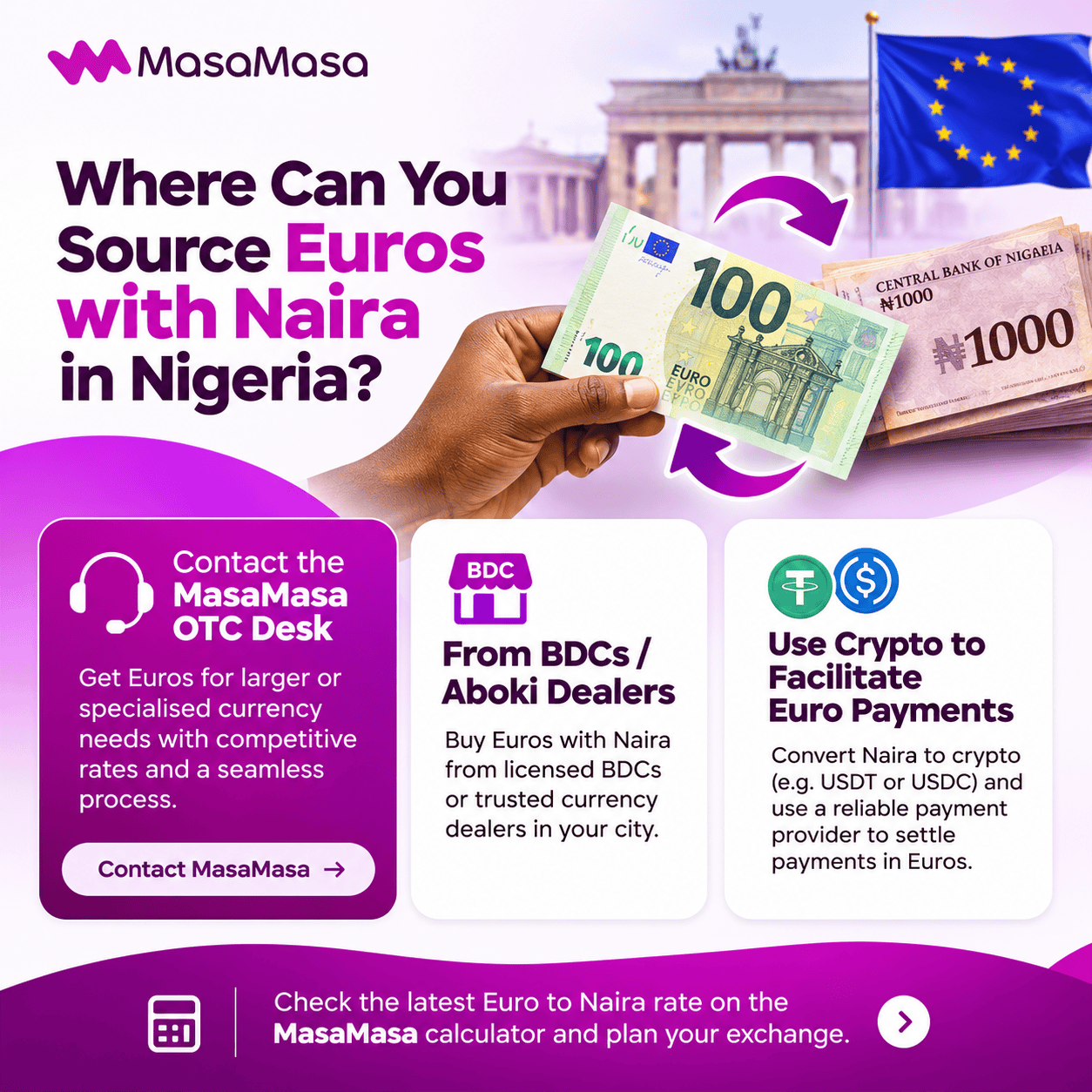
If you need Euros for international payments, travel, business transactions or personal expenses, there are several ways to source EUR using Nigerian Naira. The best option depends on how much you need, how quickly you need it and the purpose of the transaction.
Whether you are looking to buy €100, €500, €1,000 or larger amounts, here are three ways Nigerians can access Euros using Naira.
1. Contact the MasaMasa OTC Desk
One option for sourcing Euros is to contact the MasaMasa OTC Desk for assistance with larger or specialised currency conversion requirements. An over-the-counter (OTC) service can be useful for individuals and businesses that need to exchange substantial amounts without relying entirely on standard retail conversion channels.
Instead of handling a large transaction through multiple informal dealers, you can enquire about the available EUR liquidity, applicable exchange rate, transaction limits and settlement arrangements directly with the MasaMasa team.
Looking to source Euros? Contact the MasaMasa team to enquire about EUR availability, OTC conversion rates and settlement options.
Contact MasaMasa2. Buy Euros from BDCs and Aboki Currency Dealers
Another traditional way to buy Euros in Nigeria is through Bureau de Change (BDC) operators and informal currency dealers, commonly known as Aboki. These dealers operate in different Nigerian cities and may provide access to physical Euro banknotes in exchange for Naira.
Some people prefer this option when they need cash Euros for international travel, personal expenses or other transactions requiring physical foreign currency. However, exchange rates can vary between dealers, locations and transaction sizes.
Before exchanging money, verify the dealer's identity, confirm the exchange rate, check the Euro banknotes and understand the applicable transaction requirements. Where possible, use appropriately licensed and regulated foreign exchange providers rather than unverified informal dealers.
3. Use Cryptocurrency to Facilitate Euro Payments
Cryptocurrency and stablecoins have introduced another way for Nigerians to facilitate international payments involving Euros. Rather than sourcing physical Euro banknotes locally, some individuals and businesses use digital assets such as, Ethereum , Bitcoin or USDC to arrange cross-border settlements through supported and compliant payment providers.
For example, a Nigerian business that needs to pay a European supplier may acquire USDT using Naira and use a legitimate payment service that supports conversion and settlement in Euros. The provider handles the conversion and sends the agreed EUR amount to the beneficiary's bank account, subject to its supported countries, compliance checks and payment requirements.
This approach can be useful for businesses paying European suppliers, freelancers receiving international payments and individuals with legitimate cross-border payment needs. However, cryptocurrency does not automatically convert into bank-issued Euros. You need a reliable provider that supports EUR payouts, and should account for network fees, conversion spreads, transaction limits and applicable regulations.
Frequently Asked Questions About Buying Euros with Naira
1. Where can I buy Euros with Naira in Nigeria?
You can source Euros in Nigeria through licensed Bureau de Change (BDC) operators and authorised foreign exchange providers. You can also use compliant cryptocurrency-enabled payment services to facilitate international Euro payments, depending on your requirements.
2. Can I buy Euros from Aboki dealers in Nigeria?
Some Nigerians source physical Euro banknotes through informal currency dealers commonly known as Aboki. However, you should prioritise appropriately licensed foreign exchange providers, verify the source of funds and confirm the authenticity of banknotes before completing any transaction.
3. Can I use USDT or USDC to make Euro payments?
Yes. USDT and USDC can be used through supported payment providers to facilitate Euro payments. For example, you may acquire stablecoins with Naira and use a compliant provider that converts them into Euros and settles the payment into a supported European bank account.
4. What is the difference between the official Euro to Naira rate and the black market rate?
The official Euro to Naira rate is based on recognised foreign exchange market reference rates, while the black market rate refers to parallel-market quotations outside official exchange channels. The two rates can differ depending on foreign currency availability, demand and market conditions.
5. How much Naira do I need to buy €100, €500 or €1,000?
The amount of Naira required depends on the prevailing EUR to NGN exchange rate. For example, at an illustrative rate of ₦1,535 per Euro, €100 costs ₦153,500, €500 costs ₦767,500 and €1,000 costs ₦1,535,000, excluding applicable transaction fees.
6. Can Nigerian businesses pay European suppliers in Euros using cryptocurrency?
Yes. Businesses can use supported cryptocurrency-enabled payment providers to facilitate Euro settlements to eligible European suppliers. The provider must support EUR payouts and comply with applicable payment, foreign exchange and cryptocurrency regulations.
7. Is it possible to receive Euros in a Nigerian bank account?
Yes. Nigerians can receive international Euro transfers through Nigerian banks that support foreign currency accounts and incoming EUR payments. The receiving bank may have specific requirements, fees and documentation for processing international transfers.
8. How can I check the current Euro to Naira exchange rate?
You can use the MasaMasa Euro to Naira calculator to check the available EUR to NGN conversion rate. The calculator helps you estimate how much Naira you need when sourcing Euros or planning an international payment.
Table of Contents
Toggle